[Student Research]  [Research Interests] [Course Information]  [Research Awards]  [WCU Homepage]  [Useful Links]


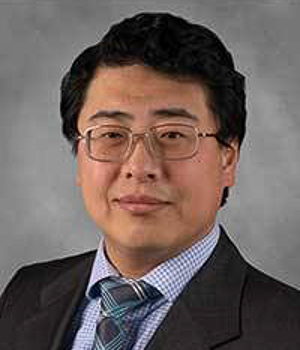
       Karyn M. Usher
         Assistant Professor
         Department of Chemistry
         West Chester University of Pennsylvania
         West Chester, PA 19383


Office Location: Schmucker Science Center 331
Phone:  (610) 436-2622
Fax:  (610) 436-2890
email: kusher@wcupa.edu


Karyn M. Usher     B.A., Ph.D.  [Florida State University]  Assistant Professor since August 2005


Course Schedule Spring 2008

Course Code Room Course Title Day Time
CHE 321-01 SS 107 Introduction to Analytical Chemistry Tues/Thurs 8-9:15am
CRL 321-01 SS 215 Analytical Chemistry Lab I Friday 1-5pm
CRL 321-80 SS 215 Analytical Chemistry Lab I Wednesday 5-9pm


Office Hours:

Tuesday            10-12 noon

Thursday           10-12 noon

Friday                9-10 am


Back to top


Research Interests and Student Research opportunities

Chromatography is a separation technique that is used in virtually all branches of science and technology.  In the chromatographic process, a mixture is introduced into the system that has been chosen for the separation, and as the mixture passes through the system different types of molecules will move at different migration rates, thus effecting a separation.  Chromatography is the most widely used of all separation techniques, and this is because of its versatility and its separation power.  It is a very powerful method that can analyze even extremely complex mixtures.  There are two main categories of chromatography, liquid chromatography and gas chromatography.  Within these two categories there are many different modes that can be utilized, and these differ in many features, such as the size of the columns used, the packing materials, or even the pressures and temperatures at which the separation is performed.  It is usually possible to find a chromatographic technique that is well suited to whatever analysis needs to be performed, due to the many different types available.  There are many things that can be varied when performing chromatographic experiments.  These include changing the type of mobile phase, the mechanism of retention, the incoming solute concentration profile, the column and planar procedures, the gradient methods, dimensionality, or even just the physical scale of the column.  Each of these changes can be used to enhance the separation from a poor separation to a good separation.

Although chromatography is widely used and embraced by scientists involved in many different types of research, there are still many questions about some of the fundamental aspects of this technique.  Many of these questions have been investigated previously, but there has been no agreement in the literature about the theory behind many of the fundamental processes.  Although everyday it becomes possible to perform more and more difficult separations, each time one of these difficult separations is achieved a more difficult one presents itself. Because of this, there is still a need for scientists to perform fundamental research in this field.  Perhaps if the mechanisms behind the separations can be better understood, scientists can decide how to go about improving the technique.  By doing so, chromatography can become an even more useful technique.

As the solutes move through the columns and are separated, the band of each analyte is broadened which gives us the peak shape that we see in liquid chromatography.  This is shown in the diagram below.  In 1956, van Deemter described the band broadening in a chromatographic system using the van Deemter equation. The A term represents eddy diffusion, the B term represents molecular diffusion, the C term represents resistance to mass transfer and u is the mobile phase velocity. Other equations have since been introduced to model efficiency data, and these include the equations of Giddings, Huber and Hulsman, Horvath and Lin, and Knox.


 H = A + B/u Cu


Band broadening even occurs outside the column in the connection tubing, detector cells, injector etc.  This type of broadening is called extra-column broadening.  The graph below shows what a graph of extra column variance (ECV) versus flow rate would be expected too look like.  As you can see, the ECV is dependent on the flowrate and its contribution becomes smaller as the flow rate is increased.  One project in my lab investigates the effects of ECV on different separations.  When the ECV is subtracted we get what is called the column variance and this includes all the band broadening that is occurring due to processes inside the column.  The second graph below shows the same data both with and without the extra column variance subtracted.  The points represent the total variance (column and extra column variance) and the lower curve represents the column variance (extra column variance subtracted).  The k’ for benzene at these mobile phase strengths is as follows:  70% ACN, k’=1.4; 80% ACN, k’=0.9; and 90% ACN, k’=0.5


There are other projects being performed in the lab, email me for more information.

Back to top


Current Research Students:

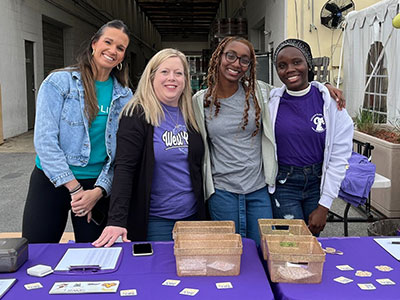
Back:  Karyn Usher (advisor), Anna Glinko (S'08), Michael Bozym (F'07, S'08)

Front:  Michelle Owens, (F'07, S'08), Casey Mulcahy (F'06, S'07, F'07, S'08)


Previous Research Students:


Andrew Newsome (F'05, S'06), Margaret Dudley(F'05,S'06), Scott Snyder(S'06, F'06, S'07, F'07), Sarat Gnanamgari (S'06), Andria Styborski (F'06, S'07), Dina Konetski (F'06),

Amber Gegg (S'07)

Back to top


Student Awards:

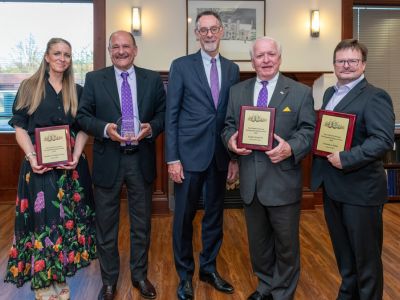
Chromatography Forum of the Delaware Valley Student Award       M. Bozym/A. Glinko/M. Owens    Spring 2008

Chromatography Forum of the Delaware Valley Student Award      C. Mulcahy/S. Snyder                    Spring 2008

CAS Student Research Award                                                        Casey Mulcahy                               Fall 2007

Eastern Analytical Symposium Student Research Award                  Andria Styborski                             Fall 2007

Sartomer Environmental Award                                                       Casey Mulcahy                               Fall 2007-Spring 2008

CAS Student Research Award                                                        A. Styborski/S. Snyder                   Spring 2006

Sartomer Environmental Award                                                       Andria Styborski                            Fall 2006-Spring 2007

Sartomer Environmental Award                                                       Andrew Newsome                         Fall 2005-Spring 2006

Grants:

Multicultural Faculty Commission 2008 Grant    Spring 2008

Agilent Technologies Chromatography Grant      Summer 2007

CAS Entrepreneur grant                                    Spring 2006

CAS Faculty Development Award                     Fall 2005

Sponsored Research Incentive Award                Fall 2005

Back to top


Selected Presentations:

Usher, Karyn M., Styborski, Andria L, Snyder, Scott H. “Extra Column Effects in HPLC: Peak Width Versus Symmetry” Eastern Analytical Symposium, Somerset, NJ, Nov 12, 2007

Usher, Karyn M, Styborski, Andria L, Snyder, Scott H. “Dispersion: Following a Band of Molecules Through the Chromatographic System” Invited seminar as part of the annual seminar       program, American University of Beirut, Beirut, Lebanon, June 27, 2007

Styborski, Andria L., Snyder, Scott H., Usher, Karyn M.  “Systematic Investigation of the Magnitude of Extra Column Dispersion in High Performance Liquid Chromatography”  39th Mid-Atlantic Regional Meeting of The American Chemical Society.  May 17, 2007

 Snyder, Scott H., Styborski, Andria L., Usher, Karyn M.  “The Extra Column Effect: Peak Width vs. Symmetry”  West Chester University All Sciences Poster Session.  May 3, 2007

Styborski, Andria L., Snyder, Scott H., Usher, Karyn M.  “The Effects of Extra Column Volume on Chromatographic Separations in HPLC Systems”  West Chester University annual Research Day.  March 29, 2007

Back to top


Interesting and Useful Links

Florida State University - Chemistry

WCU -Chemistry

HPLC Online Text

WCU Alchemist's Club

Chromatography Forum of the Delaware Valley

Back to top


[Student Research]  [Research Interests] [Course Information]  [Research Awards]  [WCU Homepage]  [Useful Links]